
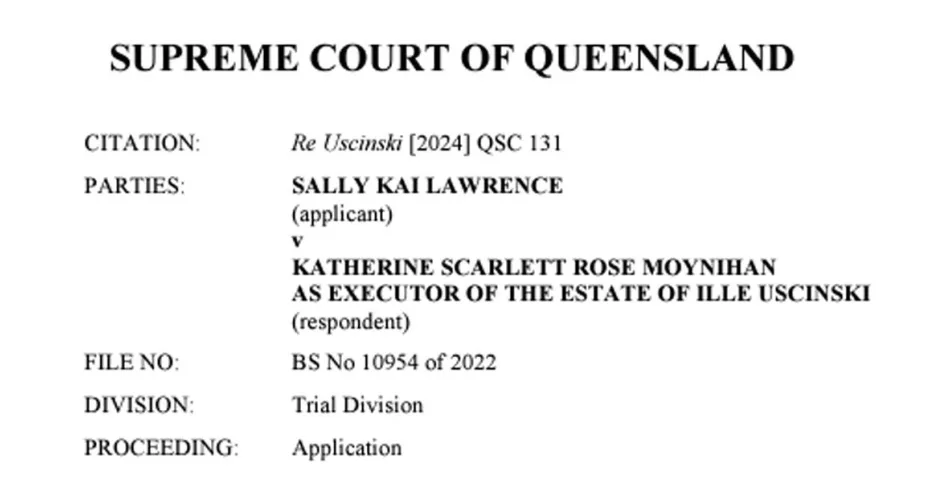
Our law firm proudly represented the applicant in the significant probate case of Re Uscinski [2024] QSC 131 in the Supreme Court of Queensland. This case provides a useful guide for situations where evidence suggests a will is invalid, such as due to lack of testamentary capacity, undue influence, lack of knowledge and approval, or suspicious circumstances, but the Court has already admitted the will to probate.
Although this issue commonly arises in practice, very few written judgments specifically address this situation. Former Chief Justice Holmes highlighted this issue in Aronis v Aronis & ors, where she noted that, “authority on the considerations relevant to the exercise of the discretion under r 640 is scant.” This decision now provides another authority for parties seeking to revoke a grant of probate.
If you are concerned about the validity of a will or a grant of probate, our team can assist with contested wills and estates matters throughout Queensland.
Background
The case involved the estate of Ille Uscinski (deceased), who passed away at 102 years of age, leaving an estate in Queensland. The deceased made a final will dated 23 January 2018 (2018 Will). The Supreme Court of Queensland admitted the will to probate in common form on 17 October 2022.
The applicant challenged the validity of the 2018 Will on the basis that the deceased lacked testamentary capacity and/or did not know and approve its contents.
To succeed in the application, the applicant did not need to prove the will was invalid. Instead, she only needed to establish a sufficient interest in the estate and show that a triable issue existed regarding the validity of the 2018 Will.
Disputes regarding testamentary capacity are becoming increasingly common in wills and estates matters, particularly where dementia or cognitive decline may have impacted decision-making.
General legal principles
Caveats
If a person has concerns about the validity of a will, they may prevent a grant of probate from issuing by filing a caveat in the Supreme Court.
A caveat allows the caveator time to investigate the circumstances surrounding the preparation and execution of the will. It also allows them to consider whether the will should instead be proved in solemn form.
You can find further information regarding probate procedures on the Queensland Courts website.
Solemn form probate
A grant of probate in solemn form requires formal Supreme Court proceedings where a judge determines the validity of the will.
This differs from probate in common form, which the registry generally grants without formal court proceedings.
Application under rule 640
If probate has already issued before a caveat is filed, the concerned party should consider filing an application under rule 640 of the Uniform Civil Procedure Rules (Qld) to return the grant of probate to the registry.
The applicant pursued this process in the present case.
These applications are costly and outcomes remain uncertain. Parties should carefully assess their prospects of success before proceeding.
If you believe a will may be invalid, obtaining early legal advice from an experienced estate litigation lawyer is critical.
The proceedings
The applicant relied on several factors to demonstrate a triable issue regarding testamentary capacity and knowledge and approval.
-
The deceased was 98 years old when she signed the 2018 Will.
-
The death certificate listed “dementia” and “frailty” as causes of death. The certificate noted those illnesses existed for “years”, which was close to the date of the 2018 Will.
-
The deceased’s signature on the 2018 Will differed noticeably from signatures on earlier wills, suggesting an enfeebled testator.
-
Earlier wills from 1991, 1996, 2003 and 2006 made significant provision for the applicant. However, the 2018 Will excluded the applicant despite no meaningful change in their relationship since around 2000.
-
The solicitor’s file note relating to the preparation of the 2018 Will revealed several concerns:
- The solicitors contacted the Law Society Ethics Department for advice regarding a doctor’s note and concerns about capacity.
- The solicitors “pre-prepared” the 2018 Will before meeting with the deceased, and it remained unclear who provided instructions.
- Family members communicated with the law firm rather than the deceased herself. Those same family members benefited substantially under the 2018 Will.
- An earlier appointment did not proceed because “Apparently the old lady became quite distressed and didn’t want to proceed on that day”.
- The solicitor asked leading questions rather than open-ended questions.
- The deceased required prompting to recall the applicant as her child, despite the will substantially disinheriting the applicant.
- The medical evidence consisted only of a doctor’s letter that did not address testamentary capacity.
The respondent’s position
The respondent argued that these factors did not raise a sufficient triable issue under rule 640.
The respondent relied on several matters, including:
-
A doctor’s letter dated 7 December 2017 stated that the deceased retained mental capacity and could understand personal and medical decisions.
-
The solicitor’s file note showed the solicitors considered capacity before taking instructions on 23 January 2018.
-
A statutory declaration signed on the same day as the will explained why the deceased excluded the applicant from the estate.
The respondent also submitted that the deceased’s age, changes in signature, dementia, and alterations in testamentary intention amounted to mere suspicion or conjecture.
The Court’s findings
However, the Court disagreed.
“However, the doctor’s letter of 7 December 2017 was not directed to the issue of testamentary capacity. The circumstance that the solicitors proceeded with taking instructions is not determinative and may, in fact, be regarded as neutral.”
The Court found that the evidence raised legitimate questions regarding the deceased’s testamentary capacity and knowledge and approval.
The Court’s decision
Justice Copley found the evidence regarding testamentary capacity and knowledge and approval was inconclusive. As a result, the Court determined that a triable issue existed.
The Court ordered the respondent executor to return the original grant of probate to the registry and commence proceedings for probate in solemn form.
This decision effectively recognised the applicant’s concerns regarding the validity of the 2018 Will.
Implications for future cases
This case provides valuable guidance for parties seeking to challenge the validity of a will after probate has already issued.
It also demonstrates the process required to overcome an earlier grant of probate before commencing proceedings challenging the will.
The decision will likely assist future applicants dealing with issues involving dementia, suspicious circumstances, undue influence, and lack of testamentary capacity.
You can read the full judgment here: Re Uscinski [2024] QSC 131.
Conclusion
If you are facing issues relating to probate, testamentary capacity, dementia, or the validity of a will, our experienced legal team can provide guidance and representation.
For more information or to discuss your matter, please contact our office. We are committed to helping clients navigate the complexities of probate and estate litigation.
Sean leads the Estate Litigation Team at Robbins Watson Solicitors, a law firm specialising in contested wills and estates. He holds a Masters Degree in Applied Law with a specialisation in Wills and Estates.
You can book a free case appraisal with Sean or one of our other Gold Coast Estate Litigation Lawyers here. You can also select Begin Online to start your estate dispute matter online.
